
Baby Nursery in Dubai: Can Your Baby Start at 45 Days?
Most parents in Dubai ask the same question a few weeks after the birth: when can our baby actually start nursery, and is it the right thing to do so early? The short answer: in Dubai a baby can join an early childhood centre from 45 days old. The longer answer depends on your work, your baby and the nursery you choose.
At Paddington Nursery in JLT we have welcomed babies from 45 days old since 2014. This guide brings together what new parents ask us most: the official age rules, how maternity leave fits in, what a good baby room looks like, how settling-in works, and what to pack on day one.

- Minimum age: 45 days. Dubai early childhood centres admit children from 45 days up to six years.
- Staff ratio for babies: 1 adult to 3 children for the 45 days to 17 months age group under KHDA guidelines.
- Why 45 days matters: private-sector maternity leave in the UAE is 60 days (45 fully paid, 15 half paid), so many families start nursery around the time leave ends.
- Plan for settling-in: allow one to two weeks of gradual adaptation before you go back to full-time work.
What is the minimum age for nursery in Dubai?
Nurseries in Dubai are licensed as early childhood centres (ECCs) and follow guidelines from the Knowledge and Human Development Authority (KHDA). Under these guidelines a child must be between 45 days and six years old to be admitted to an ECC: from the Early Learning stage for babies through to KG2 (Year 1).
At federal level, the UAE Ministry of Education also defines early childhood as the stage between 45 days and four years. So 45 days is the earliest age you will see on any nursery application form in the UAE.
Whether you are searching for an infant nursery, a baby daycare or a nursery for a newborn in Dubai, in KHDA terms they are all early childhood centres, and the same 45-day rule applies.
Nursery stages from baby room to FS2
British nurseries in Dubai that follow the Early Years Foundation Stage (EYFS) usually group children by age like this. These are the stages we use at Paddington:
| Age | Stage | Main focus |
|---|---|---|
| 45 days – 1 year | Baby room | Feeling safe, early communication, rolling, sitting, crawling |
| 1 – 2 years | Toddlers | First social steps, first words, walking and exploring |
| 2 – 3 years | Pre-nursery | Confidence, language growth, early independence |
| 3 – 4 years | FS1 | Foundations of learning, friendships, self-care |
| 4 – 5 years | FS2 | School readiness: early literacy, numbers, focus |
Why so many babies start at 45–60 days: maternity leave in the UAE
The timing is not random. Under Article 30 of the UAE Labour Law (Federal Decree-Law No. 33 of 2021), a mother working in the private sector is entitled to 60 days of maternity leave: 45 days on full pay and 15 days on half pay. She can start the leave up to 30 days before the expected due date.
After returning to work, a mother is entitled to one or two nursing breaks a day, up to one hour in total, for six months after the birth. If your nursery is close to your office, those breaks become much easier to use. This is one reason families working in JLT, Dubai Marina and Media City often choose a nursery near work rather than near home.
A simple planning timeline
- During pregnancy (2nd–3rd trimester): shortlist two or three nurseries and book tours. Baby rooms have fewer places than older groups because of the 1:3 ratio.
- Weeks 2–4 after birth: confirm your place and start the paperwork as soon as the baby's passport and residence visa are in progress.
- Weeks 5–6: agree a start date and a settling-in plan with the nursery.
- Weeks 6–8: settling-in period with short visits, so the baby is comfortable before you return to work.
- Around day 60: back to work, with nursing breaks if you need them.
Is your baby ready for nursery? Pros and cons by age
There is no single right age. Many babies settle more easily before 7–8 months, when separation anxiety typically becomes stronger. Others do well starting at one year or later. What matters most is a warm, consistent key person and a calm routine.
| Starting age | What tends to be easier | What to plan for |
|---|---|---|
| 45 days – 6 months | Babies usually accept a new caregiver easily; routine is built from the start | Feeding plan (expressed milk or formula), frequent naps, more parent communication |
| 7 – 12 months | More awake time for play and sensory exploration | Separation anxiety often peaks; allow a longer settling-in |
| 1 – 2 years | Enjoys other children, music, movement, outdoor play | Strong opinions about routine; settling may take a little longer |
Signs that you and your baby are ready are often practical: your feeding plan works away from home, you have found a nursery you trust, and you can give the baby a few gradual days before your first full day at work.
What a good baby room should look like: a parent's checklist
Take this checklist with you on every nursery tour. A good baby room is calm, clean and built around routines, not activities.
- Ratio of 1 adult to 3 babies. This is the KHDA guideline for children from 45 days to 17 months. Ask how it is kept during lunch breaks and shift changes.
- Staff experienced with babies. KHDA expects staff caring for children under three to have expertise in baby and toddler care. Ask who will be your baby's key person.
- A separate, quiet sleep area with individual cots, and naps that follow your baby's own rhythm rather than a group timetable.
- Safe milk handling: labelled bottles, a fridge for expressed milk, and a clear process for warming and recording feeds.
- Hygienic nappy-changing area separate from food preparation and play.
- Daily reports on feeds, sleep and nappies, ideally through a parent app with photos.
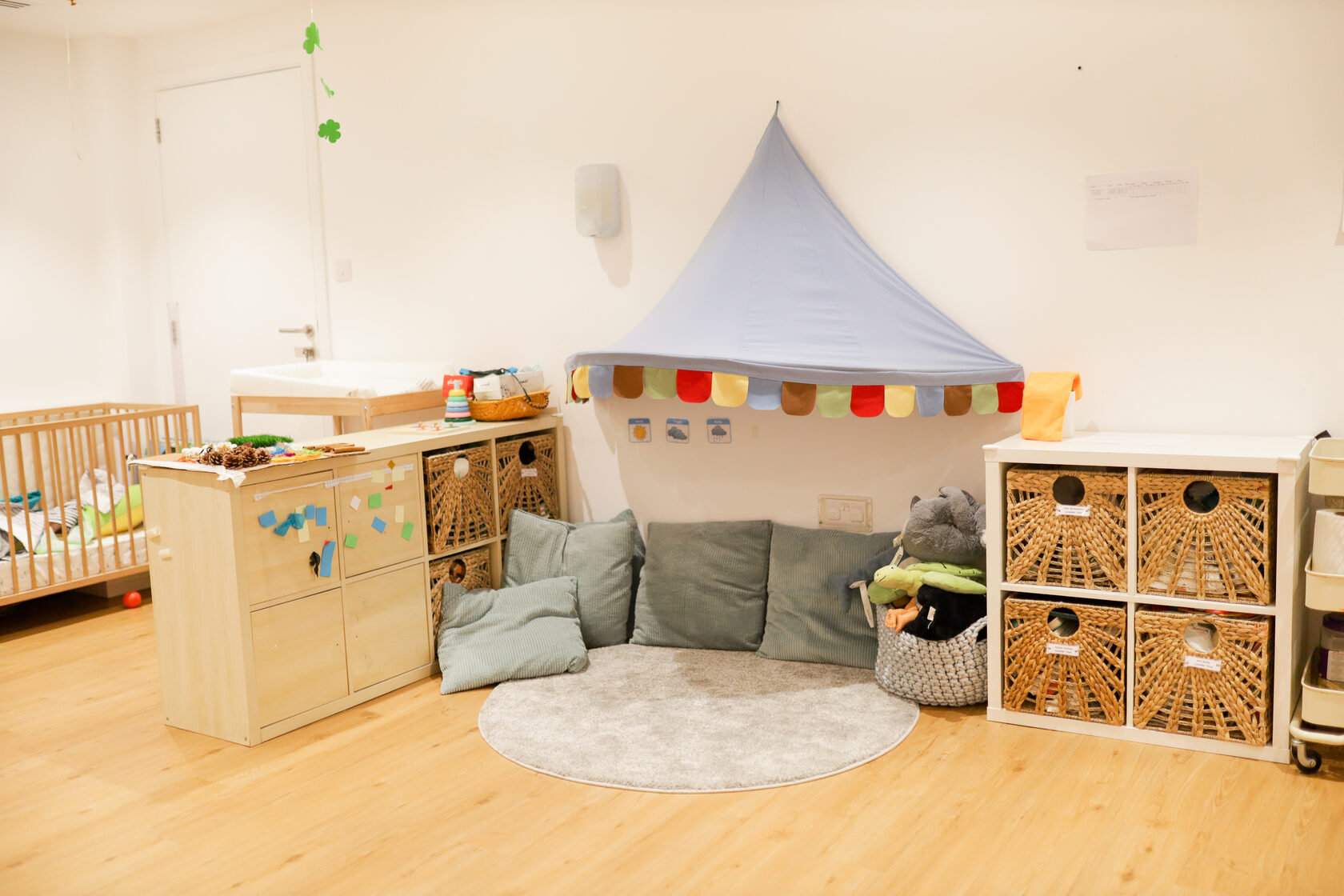
- Space to move: soft floor areas for tummy time, rolling and crawling, plus natural daylight.
- A curriculum even for babies. In the British EYFS, the first years focus on three prime areas: communication and language, physical development, and personal, social and emotional development.
Settling-in: a two-week adaptation plan
Settling-in is the most important part of starting nursery. Each nursery has its own approach, and every baby is different, but a typical plan looks like this:
| Days | Time at nursery | Parent |
|---|---|---|
| 1 – 2 | 1 hour | Stays in the room, shows the key person how the baby likes to be fed and settled |
| 3 – 4 | 1.5 – 2 hours | Says a short, calm goodbye and leaves for 30–60 minutes |
| 5 – 7 | Half day including one nap | Leaves after drop-off, collects after the nap |
| 8 – 10 | Until after lunch | Normal drop-off and pick-up |
| 11+ | Full day | Full routine |
How to make settling-in easier
- Share your baby's routine in writing: feeding times and amounts, sleep cues, favourite ways to be soothed.
- Bring something that smells of home, such as a muslin or a small soft toy (if the nursery allows it in the cot).
- Keep goodbyes short and consistent. Long goodbyes are usually harder for parents than for babies.
- Expect a few tired days and the odd cold in the first months. It is normal and usually settles down.
What to pack for baby's first day at nursery
Labelled bottles, expressed milk or formula, bibs, and first foods if your baby has started weaning
Nappies, wipes, nappy cream, and two or three full changes of clothes
Sleeping bag or light blanket, dummy if used, and a comforter that smells of home
Label everything with your baby's name. In Dubai's climate, choose light cotton clothes and add a hat for outdoor time in the cooler months.
Documents you will need to register a baby at nursery
The exact list varies, so always check with the nursery, but most early childhood centres in Dubai ask for:
- Completed registration form and signed policies
- Baby's birth certificate
- Copies of the baby's passport and UAE residence visa or Emirates ID (or proof that they are in progress)
- Parents' passports and Emirates IDs
- Vaccination record
- Passport-size photos of the baby
- Emergency contacts and a list of people allowed to collect the child
Babies born in the UAE need a visa within a set period after birth, so start the paperwork early. Your nursery can usually hold a place while documents are being processed.
Babies at Paddington Nursery JLT
Paddington Early Childhood Centre has cared for babies and young children aged 45 days to 5 years in Jumeirah Lakes Towers since 2014. We follow the British EYFS framework with a child-centred, play-based approach adapted to each child.
- Bright, spacious rooms with floor-to-ceiling windows and carefully chosen resources for sensory exploration.
- Next to JLT Park. In the cooler months, children spend mornings at the playgrounds and on the lawn.
- Indoor gym and playground so children can move freely even in the Dubai summer.
- Parent app showing your child's meals, sleep, photos and progress during the day.
- Meals your way: bring food from home under our lunch box policy, or choose freshly prepared meals from our catering partner Baby Eats.
- Open all year round, 8am to 6pm, with holiday camps during academic breaks.
Read more about our EYFS stages from 45 days to FS2 or see the nursery spaces.
Armada Towers, Cluster P, JLT · Open daily 8am–6pm
FAQ
What is the youngest age a baby can start nursery in Dubai?
45 days. KHDA guidelines allow early childhood centres in Dubai to admit children from 45 days to six years old.
How many babies can one teacher look after in Dubai?
For babies aged 45 days to 17 months, the KHDA guideline is one adult for every three children. The ratio increases gradually with age, up to 1:12 for children aged 48 to 71 months.
Is it bad to start nursery at 2–3 months?
Not necessarily. Many babies adapt well at this age, especially with a consistent key person, a calm routine and a gradual settling-in period. The most important factors are the quality of care and a plan that works for your family.
Can I still breastfeed if my baby goes to nursery?
Yes. You can provide expressed milk in labelled bottles, and in the private sector you are entitled to nursing breaks of up to one hour a day for six months after the birth. A nursery close to your workplace makes this easier.
How long does settling-in take?
Usually one to two weeks, starting with short visits with a parent and building up to a full day. Some babies settle in a few days, others need a little longer.
When should I apply for a baby place?
As early as possible, ideally during pregnancy. Baby rooms have fewer places than older groups because of the 1:3 staff ratio.
Sources
- Gulf News: Dubai sets admission age for early childhood centres (KHDA guidelines)
- UAE Government portal: Maternity leave in the private sector
- UAE Government portal: Early childhood development and care
- Gulf News: KHDA sets new health and safety standards for Dubai's early childhood centres
- GOV.UK: Early years foundation stage (EYFS) statutory framework
This article is for general information. Rules and requirements can change, so please check the latest guidance with KHDA and your nursery.
